

Your Barabazar shop is getting very busy, your supplier says that he wants payment and your bank is requesting property papers. There is no need to sacrifice your family home in order to have to restock the shelves. Which is why there are collateral free retail loans?
In this post, I will guide you on how they work, who can take part in them and what they actually cost and how merchants from all over Kolkata, Howrah and Hooghly can join them.
What Are Collateral Free Retail Loans?
Essentially they are retail loans without the backing of any property, gold or any machinery. It’s as if a shop owner extends a credit to a shopper that they’ve been known to do. It’s like a store owner extending a credit to a customer who they have had a history of giving credit too in the past.
How Lenders Decide Without Property
Your cash flow, bank statements, GST or UPI turnover and credit score are considered by the lender. Eagerly awaited are the daily sales of your shop; your “security” in spirit.
Common Types
- Unsecured business loan: a single payment of money for stock, repairs or employees.
- Working capital loan: small amounts of money for day to day expenses.
- Overdraft: you only pay interest on the amount that you borrow.
All these are covered under a collateral free loan for MSME if your shop is registered or eligible to get registered.
Why Local Shopkeepers Need Them for Collateral Free Retail Loans
In Howrah, Shyambazar or Hooghly be it any grocery, mobile grocery or medicine shop, there are hardly any days when cash flow runs smoothly. During Puja season, the animals need to be well-fed. The suppliers demand payment up front. Customers pay late. You can get over that hurdle with a quick unsecured business loan that doesn’t require you to freeze your assets.
Government-Backed vs Private Options
Not all loans that are made without collateral are created equal. Here’s the difference.
CGTMSE
It is this scheme that the old RetailPe post has got wrong. There is no money available from CGTMSE (Credit Guarantee Fund Trust for Micro and Small Enterprises). It ensures that your lender will have a bit of your loan, in other words will be safe if you don’t pay back your loan. The cover is reported to be up to ₹10 crore for micro and small enterprises, although it varies according to types of enterprises. There is no direct application process; it’s through a participating lender. Please verify with the lender the current limits.
PSB Loans in 59 Minutes
This government initiative provides in-principle approval of MSME loans with data from the GST, income tax and banks spanning from ₹1 lakh to ₹5 crore. Of course there is a lag time for final sanction and disbursal on principle.
NBFC and Fintech Lenders
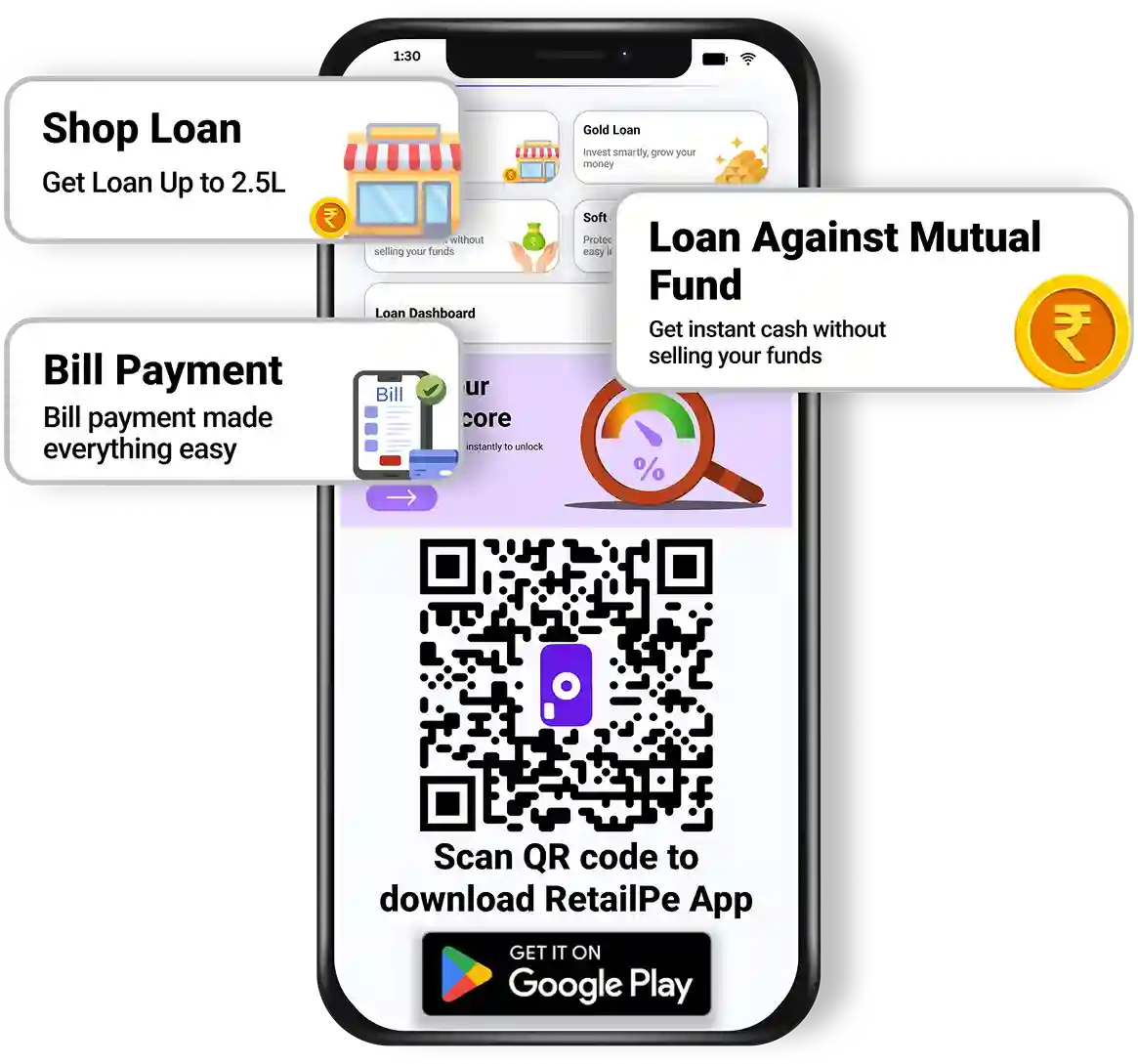
Often NBFCs will be quicker and easier to process, but will often cost more. Some of the published NBFC listings indicate the rates as 20 – 35% and processing fee up to 2%. Banks offer less expensive, but more demanding services. RetailPe operates via an NBFC partner registered with RBI, and a digital platform for retail shops.
Eligibility and Documents for Collateral Free Retail Loans
This will vary from lender to lender, but most lenders will require:
- A business that is still active (usually from 6 months – 2 years)
- An acceptable credit score (few lenders like to see a credit score of 650 or higher)
- If you see regular activity on your bank account, that’s a sign. If there is regular turnover in your bank account, then it’s a sign
- Business proof of any kind (Udyam registration)
Documents You Need
- PAN and Aadhaar
- Shop address proof
- 6–12 months’ bank statements
- GST returns (on registration)
What If You Lack Financial Statements?
There are lots of little shops that don’t have audited accounts. Don’t panic. Bank statements and UPI sales data are used by digital lenders, however. Get the customers’ payments routed through your business account, today. It creates the lenders’ record.
The Real Cost of Collateral Free Retail Loans
Earning of “collateral free,” does not imply “cost free.” As a result, lender’s rates will typically be higher. Before signing, check:
- The interest rate and paid off in reducing balance
- Processing and documenting fees
- A one-time fee that is imposed when a real estate loan is either foreclosed or prepaid
- Late-payment penalties
Take the example of a loan of ₹2 lakh for 12 months on 24% interest; this is a quite high interest rate that will make them pay more than they borrowed. Take a calculator to an EMI and make sure that the EMI payment suits your day-to-day sales, rather than your day-to-day wishes.
Keep in mind that no approval is a given. All credit decisions are made after a risk assessment, even RetailPe’s own disclaimer states.
How to Apply on Retail Pe
- Check eligibility. Be familiar with your turnover and credit score.
- Fill the online form. To begin, make sure to have the name and phone number on hand.
- Double check you are mobile with an OTP.
- Upload documents. Bank statement, proof of identity and business.
- Review the offer. Take the terms and conditions of the rate, fee and tenure, carefully.
- Accept and receive funds approvals.
Shop around to get the best deal. It will take an hour, and save thousands.
Tips to Improve Approval
- Have a tidy bank statement: no bounced cheques.
- Always make timely payments of their EMIs and credit card bills.
- Review credit report for errors and correct them.
- Carefully consider how much to borrow based on the amount of money you’re able to sell.
- Keep simple, regular books, even a habit of using a notebook to make spreadsheet.
Mistakes to Avoid
- Avoiding the first option that you see. Rates vary widely.
- Ignoring hidden charges. Read key fact statement.
- Over-borrowing. The higher the amount of loan, the higher will be the EMI.
- Trusting unverified apps. Only use lenders that have been registered by RBI.
- The term “no collateral” means “no liability on my part. There are still some lenders who will require a personal guarantee.
Conclusion
Collateral free retail loans are a boon for shop keepers in Kolkata, Howrah and Hooghly to avail working capital in absence of risking your home or shop. Think carefully know schemes such as CGTMSE, and research banks and NBFCs; and understand the financial cost before applying. Get your paperwork in order, maintain good bookkeeping and only borrow as much as your shop can afford to pay back. Ready to move? Find out if you’re eligible on RetailPe today.
FAQs
1. What are collateral free retail loans?
Ans) They are retail loans which are provided without the pledge of property or gold. Creditors assess you based on your credit score, business cash flow and bank statements.
2. Is CGTMSE a loan I can apply for directly?
Ans) No. CGTMSE guarantees your loan to the lender. An application is made to the participating bank or NBFC and the bank or the NBFC asks for the cover.
3. Can a new shop get a collateral free retail loans?
Ans) It’s harder. While many lenders require six months to two years in business, some fintech lenders will look at data from bank accounts and UPI.
4. Are collateral free retail loans more expensive?
Ans) Generally, yes because if the lender has more risk. Before opting for a bank or NBFC, read the rates, processing charges and prepayment costs of each.
5. How can I improve my approval chances in Kolkata, Howrah or Hooghly?
Ans) Keep GST and KYC documents on hand, do not buy on the run, keep bank account for route and maintain healthy credit score.


